
The Pythagoras theorem which is also referred to as the Pythagorean theorem explains the relationship between the three sides of a right-angled triangle. According to the Pythagorean theorem, the square of the hypotenuse is equal to the sum of the squares of the other two sides of a triangle. Let us learn more about the Pythagoras theorem, the Pythagoras theorem formula, and the proof of Pythagoras theorem along with examples.
The Pythagoras theorem states that if a triangle is a right-angled triangle, then the square of the hypotenuse is equal to the sum of the squares of the other two sides. Observe the following triangle ABC, in which we have BC2 = AB2 + AC2. Here, AB is the base, AC is the altitude (height), and BC is the hypotenuse. It is to be noted that the hypotenuse is the longest side of a right-angled triangle.

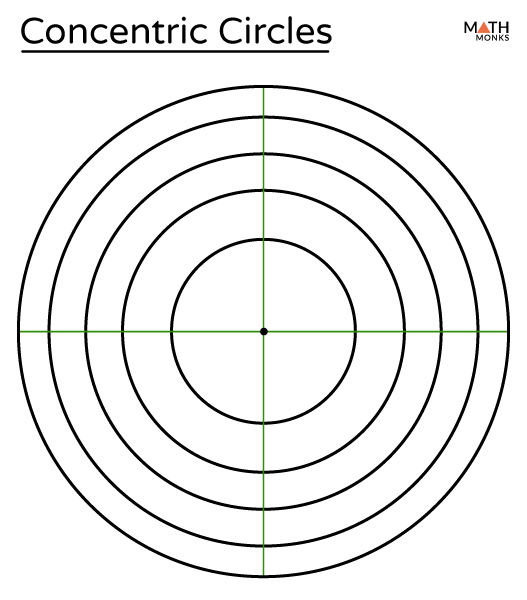
Concentric circles are defined as two or more circles that share the same center point. They fit inside each other and are of the same distance from the center.
See the diagram below. It shows 2 concentric circles having a common center point.

Upon entering school, students begin to develop their basic math skills. Mathematics makes it possible for students to solve simple number based problems. Through the use of math, students can add up store purchases, determine necessary quantities of objects and calculate distances. While the discipline of math does become quite complex, there are some basic math skills that every student can and should learn during their math education program.
The first mathematics skill that students learn is basic number sense. Number sense is the order and value of numbers. Through the use of their number sense, students can recall that ten is more than five and that positive numbers indicate a greater value than their negative counterparts. Students commonly begin learning number sense skills in pre-school, and continue developing a more complex understanding of the concept throughout elementary school. Teachers introduce this skill to students by having them order digits and complete basic counting activities. They extend their knowledge by introducing the concept of the greater than and less than symbols and explaining what the use of each indicates.
The first mathematical operation that students learn is addition, followed closely by subtraction. Students begin studying these skills through the use of manipulatives, or physical tools that represent objects, as early as pre-school, and continue building their skills, adding and subtracting ever larger numbers through elementary school. When the skills are initially introduced, students perform rudimentary calculations using single digits. Later in their study, they practice applying these skills through the completion of story problems.
~William L. Schaaf, Nature and History of Pi
Pi (often represented by the lower-case Greek letter π), one of the most well-known mathematical constants, is the ratio of a circle’s circumference to its diameter. For any circle, the distance around the edge is a little more than three times the distance across.
Typing π into a calculator and pressing ENTER will yield the result 3.141592654, not because this value is exact, but because a calculator’s display is often limited to 10 digits. Pi is actually an irrational number (a decimal with no end and no repeating pattern) that is most often approximated with the decimal 3.14 or the fraction
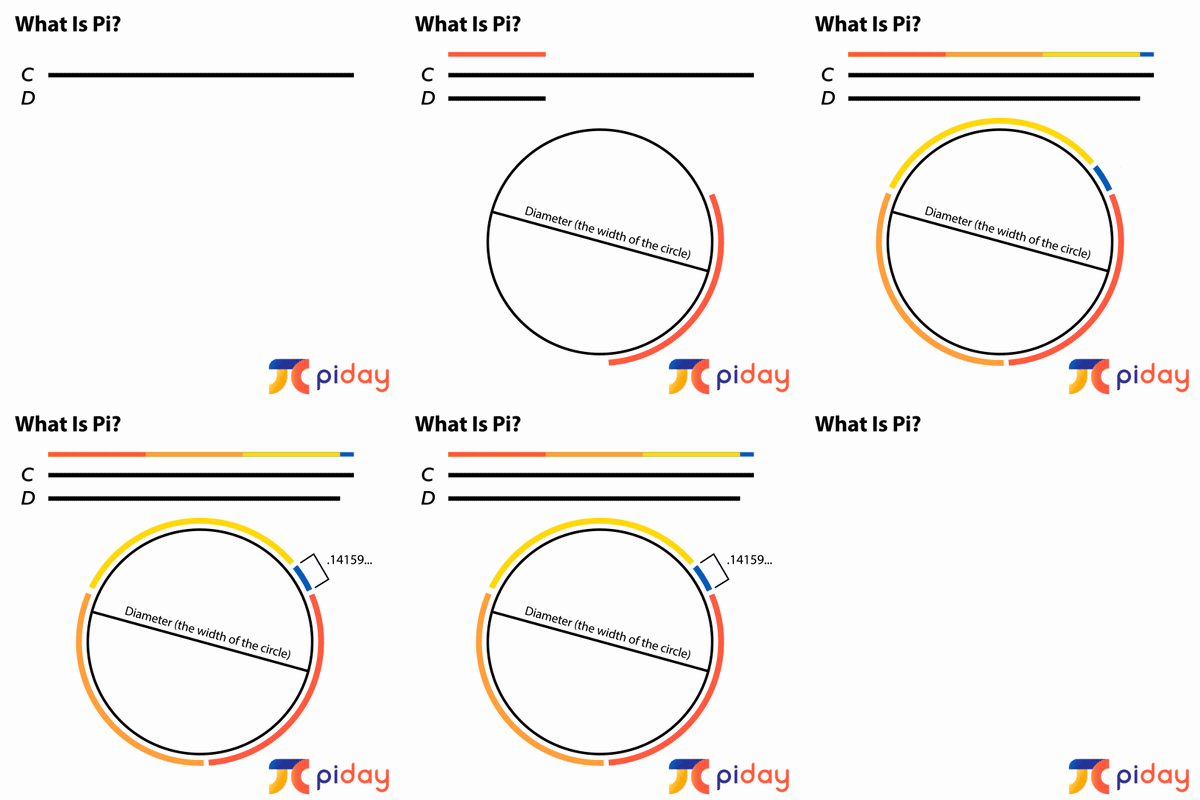
This brings up a rather interesting question: If pi is the number of diameter lengths that fit around a circle, how can it have no end?
Pi has interested people around the world for over 4,000 years. Many mathematicians – from famous ones such as Fibonacci, Newton, Leibniz, and Gauss, to lesser well-known mathematical minds – have toiled over pi, calculated its digits, and applied it in numerous areas of mathematics. Some spent the better parts of their lives calculating just a few digits. Here is a sampling of the many milestones in the life of pi.
Early decimal approximations for pi were obtained in a number of different ways. For example, in ancient Babylon, rope stretchers marking the locations of buildings and boundaries estimated pi to be
Archimedes, a Greek mathematician, was the first to use an algorithmic approach to calculate pi. He drew a polygon inside a circle and drew a second polygon outside of the circle. Then he continuously added more and more sides of both polygons, getting closer and closer to the shape of the circle. Having reached 96-sided polygons, he proved that

From Archimedes’ time (about 250 B.C.E.) to the early 1600s mathematicians in countries around the world used methods similar to Archimedes’ to estimate pi, with increasingly efficient and accurate results. In 1630, Austrian astronomer Christoph Grienberger calculated 38 digits of pi using polygons with 1040 sides, which remains the best calculation of pi using this polygonal method.
The Renaissance saw many developments and work on pi, including the creation of the name pi. Until 1647, it didn’t have a universal name or symbol. English mathematician William Oughtred began calling it pi in his publication Clavis Mathematicae, but it wasn’t until Leonhard Euler used the symbol in 1737 that it became widely embraced. The reason for adopting this particular Greek letter is because it is the first letter of the Greek word, perimetros, which loosely translates to “circumference.”
So, on some level, the problem here is the that is in front of the exponential. If that wasn’t there we could do the integral. Notice as well that in doing integration by parts anything that we choose for will be differentiated. So, it seems that choosing will be a good choice since upon differentiating the will drop out.
Now that we’ve chosen we know that will be everything else that remains. So, here are the choices for and as well as and .
The integral is then,
Once we have done the last integral in the problem we will add in the constant of integration to get our final answer.
Note as well that, as noted above, we know we made made a correct choice for and when we got a new integral that we actually evaluate after applying the integration by parts formula.
We need to choose . In this question we don't have any of the functions suggested in the "priorities" list above.
We could let or , but usually only one of them will work. In general, we choose the one that allows to be of a simpler form than u.
So for this example, we choose u = x and so will be the "rest" of the integral, dv = sin 2x dx.
We have so .
Also and integrating gives:
Substituting these 4 expressions into the integration by parts formula, we get (using color-coding so it's easier to see where things come from):
TONGUE TWISTER A tongue twister is “a sequence of words or sounds, typically of an alliterative kind, that is difficult to pronounce qui...